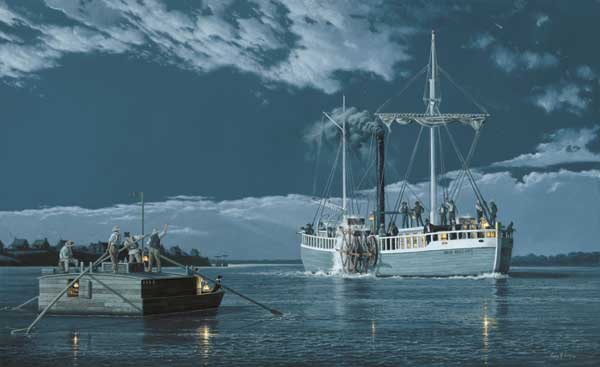
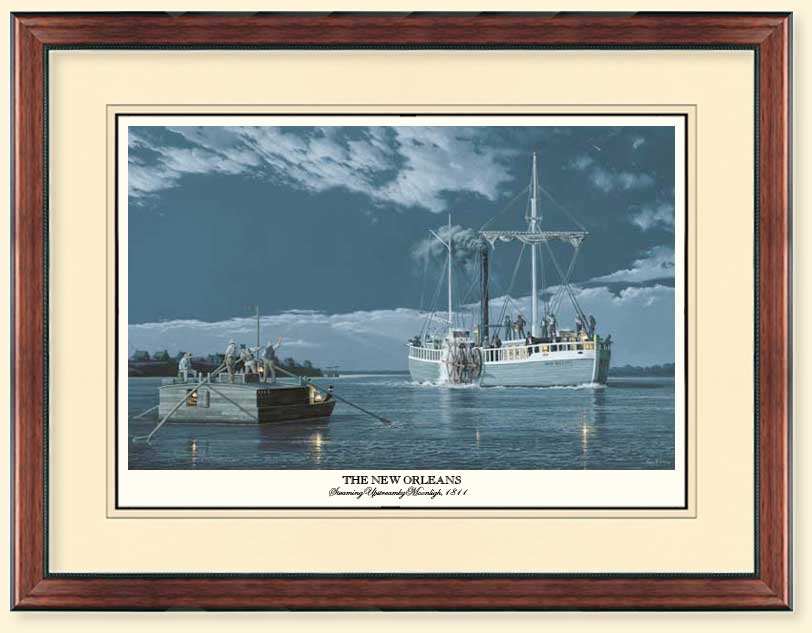
THE NEW ORLEANS
Steaming Upstream by Moonlight, 1811
The New Orleans was built in
Pittsburgh for
a cost of $38,000. The design was that of Robert Fulton. Financing for
the project came from Robert Livingston: and, the boat was in the
charge
of Nicholas Roosevelt.
The vessel was the first steamboat on the
western rivers. Thus, she represented the introduction of steam
technology
to the western frontier. After Lewis and Clark returned to St. Louis in
1806, the launching of the New Orleans could be said to have been the
next
major historic event in the development of the West.
The New Orleans was to descend the Ohio and
the Mississippi River to her service destination, the city of New
Orleans,
where she would work the lower Mississippi River trade. On October 1,
she
arrived and dropped anchor in the middle of the Ohio River at
Louisville,
Kentucky. She arrived in the middle of the night; and, as she let off
her
steam pressure, the sound awakens the sleeping residents of the small
frontier
town. For the past few evenings, the residents had observed a comet in
the sky. Before the sleeping town could find their way out of their
homes
many thought for sure the comet had fallen from the sky and landed in
the
river. If you look carefully, the comet can be seen in the upper right
hand comer of my painting.
On one of the following evenings the citizens
of Louisville invited the Roosevelt family ashore for dinner. At
dinner,
Roosevelt told of how the New Orleans had the ability to steam upstream
without the aid of pole, paddle, cordell rope, or sail. This concept
was
not imaginable by his dining companions. To return the hospitality an
invitation
was extended to his hosts to dine aboard the New Orleans the following
evening. While dining in the forward cabin, the guest heard a loud
clatter
and felt the boat begin to move. Terrified, the guests thought the
vessel
was dragging anchor and they were all going over the falls and would be
killed. As they rushed up on deck, they realized, as Roosevelt had told
them, the New Orleans had the ability to navigate upstream as well as
down
stream under her own power. In the painting, we see a moment in time
when
the business owners and leaders of the community must be gazing over
the
bow thinking about the future and what steam power will mean to them.
The
depiction of the flatboat in the foreground floating with the current
away
from the viewer and the depiction of the New Orleans making way
upstream
under its own power is a symbolic gesture outlining a point in the
history
of the United States where an old technology makes way for the new.
As the New Orleans makes its way down the
Ohio and Mississippi Rivers, she finds herself in the middle of one of
the greatest earthquakes in American history, the New Madrid earthquake
of 1811-12. The Native Americans felt that the earthquake was caused by
the appearance of the comet and this loud hissing steamboat, they
called
the "fire canoe".
|