
Inland Waterways: The Highways of Our Heritage Approximately twenty years ago, I set a goal for myself to have a showing of my work with the Jefferson National Expansion Memorial at the Old Courthouse Museum in Downtown St. Louis. The title of the showing would be Inland Waterways: The Highways of Our Heritage. The show would be an effort to tell the story of the Inland Waterways of America using my historic research to create a series of paintings depicting our river heritage. This twenty year retrospective collection of my work began September 3, 2004 and will run through January 9, 2005. 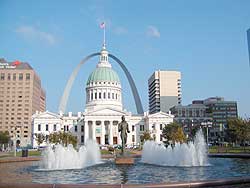 I refer to my efforts in depicting this heritage as “The Art of Visual Historic Interpretation”. Historic interpretation is not new to the art world. In fact, visual historic interpretation can be traced to the first cave paintings tens of thousands of years ago. The first man to draw on a cave wall depicting his interpretation of his clan’s past activities was the first artist to practice “The Art of Visual Historic Interpretation”. Most historians read and research, then express themselves in either a text or verbal format. I follow the same route as my fellow historians; however, I prefer to interpret visually. To give another example of “The Art of Visual Historic Interpretation”, not because of its religious significance but because the painting is universally recognized, is Leonardo’s Last Supper. This is a painting depicting an event that happened 1500 years prior to the creation of the work. Thus, you should be able to recall many artists that have employed this process. My work with historic subjects is not new, just a continuation of an artistic heritage. For this showing, the museum has been so kind as to allow me to use all their non-permanent exhibit space, which includes two floors of the rotunda and the west wing of the building. I will be giving several lectures during the exhibit to explore the history behind my paintings and the process used to complete the works. For a complete listing of the lectures, dates, times, and subjects, please visit my web site, www.garylucy.com, and look under the heading of Inland Waterways: The Highways of Our Heritage. I hope you will be able to visit my showing.
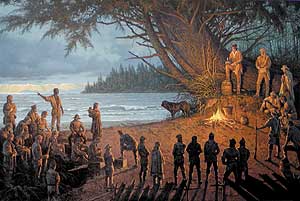
My most recent painting is, for now, my final work dealing with the subject of Lewis and Clark. The Vote is an interesting event that took place at the mouth of the Columbia River. There were thirty-one men, one woman, one baby, and one big dog camped at a location the crew named Station Camp. This camp, located on the northern side of the river, was a welcome respite from days of endless rain and wind. Lewis writes in his journals that he is becoming worried about the physical welfare of the men because their leather clothing is literally rotting off their bodies exposing their skin to the elements. It is very apparent that winter quarters must be found. The Captains asked the members of the expedition to vote for the location where they felt the living conditions and food supply would be best. All members had a vote including York and Sacajawea. It is thought that because the vote was sanctioned by a ranking member of the United States Government, Meriwether Lewis, this action would have marked a milestone denoting one of the first black men and one of the first women to vote in this country. As we view the painting, we see York standing, speaking, and pointing across the river, thus, making his vote known.  The River Rover: A New River Studio If you have been following my web page or my newsletter over the past few years, you will remember that I have traveled literally thousands of miles aboard the Custom Canvas Cruiser, CCC for short. For the past eleven years, my canvas enclosed twenty-four foot pontoon boat has served as my river studio. However, the fleet is getting larger. The CCC has been joined by a thirty-five foot houseboat, the River Rover, as a second river studio. My plans are to keep the CCC because it is easy to move overland for special research projects. 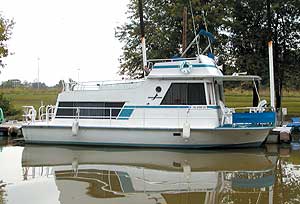
Southeast Missouri State University is designing and will be building
a new River Campus in Cape Girardeau, Missouri, to house a new School of
Visual and Performing Arts. The thirty-eight million dollar facility will
be the new home for the University's departments of art, music, and theatre
and dance. The buildings of Saint Vincent's College, founded in 1843 on
a lofty bank above the Mississippi River in historic downtown Cape Girardeau,
will be renovated by the University and expanded with an extensive new
building project to include classrooms, studios, a recital hall, and a
1,000-plus seat, state of the art, theater. The River Campus grounds will
include a new river overlook and trail for public use. In addition, the
new facility will house a regional history museum with a permanent exhibit
based on the theme of "crossroads," including the story of Cape Girardeau's
and the southeast Missouri region's legacy with the Mississippi River.
Because a new bridge has been built across the Mississippi River adjacent
to the site, the traveler from Illinois to Missouri will be greeted by
a new Missouri affiliated welcome center adjacent to the regional museum
on the River Campus. The University expects to begin renovation and new
construction in the Spring of 2005, with a completion date in 2007.
|
 Commission
to complete a mural
Commission
to complete a mural