 Sandy
and I made the pilgrimage to Charlottesville, Virginia in January of this
year to attend the first Signature Event celebrating the 1803 beginning
of the Lewis and Clark Expedition. I found the trip and the information
regarding Thomas Jefferson to be extremely rewarding. If you have been
studying the Lewis and Clark Expedition, you must take a close look at
the life, philosophy, and teachings of Thomas Jefferson. Sandy
and I made the pilgrimage to Charlottesville, Virginia in January of this
year to attend the first Signature Event celebrating the 1803 beginning
of the Lewis and Clark Expedition. I found the trip and the information
regarding Thomas Jefferson to be extremely rewarding. If you have been
studying the Lewis and Clark Expedition, you must take a close look at
the life, philosophy, and teachings of Thomas Jefferson.
I came away from Monticello, Charlottesville, and the University
of Virginia, the University Thomas Jefferson founded, with a new perspective
of the Lewis and Clark journey and its meaning. The journey was a long
and arduous voyage froth with dangers and physical tests that would kill
95% of the American population today. However, such journeys of equal or
greater danger and peril have been attempted and successfully completed
in the history of man. The danger and the hardship are major elements of
the journey. However, in my opinion, not the predominate issues.
The main reason that the Lewis and Clark Expedition was important to
America may be stated as follows: The Lewis and Clark Expedition was The
Vine that Grew from the Seeds of Freedom. The seeds were the ideas fostered
by the founding fathers of this country and their foresight and efforts
to build America and the American ideal of freedom. As we know, many of
those ideals were shared by and came from the pen of Thomas Jefferson.
Thus, those seeds came to be planted in the fertile mind that was Jefferson's
garden. The strongest vine that grew from those seeded was in the personage
of Meriwether Lewis. Jefferson took a personal interest in Lewis and became
a mentor to the young man through his personal teachings. Jefferson, after
becoming President, asked Lewis to be his personal secretary in the White
House and began to provide him with the best training from the best
minds of the day in preparation to send Lewis on the famous journey that
lasted more than three years. This journey produced journals
destined to be an endearing and most valuable record of the expedition,
the geographic region of the West, the flora and fauna, and the people
of that land. But most importantly, the journey from Washington D.C. to
the Pacific Ocean and back completed the growth of a new and strong vine
that laced this country together for the first time. Lewis and Clark opened
the West; thus, making the assets of the West available to a new and growing
young country.
My motive in producing the painting, LEWIS and CLARK: The Departure
from the Wood River Encampment, May 14, 1804, was to depict a moment in
time of significant importance to the development of the United States.
The painting marks the formal entrance of the first official government
representative to the West after it has become a possession of our country.
This moment is important, in my opinion, because of the access to the enormous
amounts of natural resources and the addition of a vast landmass to the
current holdings east of the Mississippi River; thus, doubling the size
of the United States at that time. 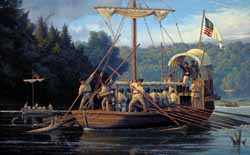 Although
the elusive Northwest Passage was found not to exist, the Lewis and Clark
voyage clarified the scope and breadth of America; thus, their findings
served as a giant step to unite the oceans of the Atlantic and Pacific
for trade purposes. In my opinion, this moment also marks the beginning
of the United States' ascension to the position of the leading world power
it is today. The European countries were depleting many of their natural
resources. The addition of the Louisiana Territory and later the lands
extending to the Pacific Ocean, in addition to the original eastern half
of the United States, provided vast wealths of wood. Used for the building
of a new country, wood was one, if not the leading, natural resource of
the nineteenth century. The vast forests of this country provided
the material for the building of all forms of transportation and the fuel
to propel them not to mention the homes and infrastructure for a growing
country. Coal and iron were also elements in abundance used in the mid
to latter-half of the nineteenth century and into the twentieth to feed
the needs of this nation. The United States had become a stand-alone empire.
Its abundance of natural resources, the strong will of its people, and
its strategic geographic location blessed with fertile soil and a receptive
climate together with an isolated location in the world with room to grow
and be protected from the turmoil of the world. Due to these unique
characteristics, the next two hundred years has allowed the United States
to grow, bloom, and produce a bounty of overwhelming proportions. As we
moved through the twentieth century and into the twenty-first century,
we have developed a need for another natural resource not totally indigenous
to our country, oil. The world is a smaller place today; and, we are not
geographically protected any more. Planted and nurtured by Jefferson, The
Vine that Grew from the Seeds of Freedom has grown through the generations
of two hundred years into a tower of strength. May that wise, powerful,
and vigilant vine continue to grow and protect us. Although
the elusive Northwest Passage was found not to exist, the Lewis and Clark
voyage clarified the scope and breadth of America; thus, their findings
served as a giant step to unite the oceans of the Atlantic and Pacific
for trade purposes. In my opinion, this moment also marks the beginning
of the United States' ascension to the position of the leading world power
it is today. The European countries were depleting many of their natural
resources. The addition of the Louisiana Territory and later the lands
extending to the Pacific Ocean, in addition to the original eastern half
of the United States, provided vast wealths of wood. Used for the building
of a new country, wood was one, if not the leading, natural resource of
the nineteenth century. The vast forests of this country provided
the material for the building of all forms of transportation and the fuel
to propel them not to mention the homes and infrastructure for a growing
country. Coal and iron were also elements in abundance used in the mid
to latter-half of the nineteenth century and into the twentieth to feed
the needs of this nation. The United States had become a stand-alone empire.
Its abundance of natural resources, the strong will of its people, and
its strategic geographic location blessed with fertile soil and a receptive
climate together with an isolated location in the world with room to grow
and be protected from the turmoil of the world. Due to these unique
characteristics, the next two hundred years has allowed the United States
to grow, bloom, and produce a bounty of overwhelming proportions. As we
moved through the twentieth century and into the twenty-first century,
we have developed a need for another natural resource not totally indigenous
to our country, oil. The world is a smaller place today; and, we are not
geographically protected any more. Planted and nurtured by Jefferson, The
Vine that Grew from the Seeds of Freedom has grown through the generations
of two hundred years into a tower of strength. May that wise, powerful,
and vigilant vine continue to grow and protect us.
Future Lewis and Clark Paintings
I will continue to work with the subject of Lewis and Clark as part
of my series Inland Waterways: The Highway of Our Heritage. Currently,
I am working on some small paintings. However, in the early part of 2004,
I will start another major work entitled: LEWIS and CLARK: The Vote, November
24, 1805. The painting will depict an interesting event during the voyage.
All members of the Corps were allowed to vote on a location for the winter
campsite to be located at the mouth of the Columbia River. Sacajawea
and York were given a vote. And, the vote was recorded by Lewis, an official
representative of the United States Government. This would mark the first
time a women/native American and an African-American were given the right
to vote in this country. In preparation for the painting, I will be going
to Ft. Clatsop in November to visit the November 24th campsite location
to research the land, the elements and seascape at that time of the year.
I think I will bring my new rain jacket.
The Captain's Gallery Auction
Another interest experiment I am conducting on our web site is an auction.
At this time, we have auctioned several small original oil paintings. The
response has been good. Please take the time to stop by the web site at
www.garylucy.com to see the current work being auctioned. I hope to have
a new piece at least every other month.
 ReDiscovery
2003 ReDiscovery
2003
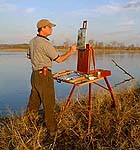
By the time this publication reaches you, I will have spent six weeks
on the Ohio River with the St. Charles Corps of Discovery retracing the
1803 path of Lewis and the men under his command from Elizabeth, Pennsylvania
to Louisville, Kentucky. I will try to paint and sketch along the way including
some on-location painting. The paintings and sketches as well as my daily
journal I hope to keep and upload to the internet from my studio boat,
the Custom Canvas Cruiser, will be on my web site www.garylucy.com.
Stop by and enjoy my visions of the journey.
Inland Waterways: The Highways of Our Heritage
September 2004 - January 2005
The time is drawing near. My twenty year retrospective show to be
exhibited with the Jefferson National Expansion Memorial at the
Old Courthouse Museum in St. Louis will be opening next year. Yes, I have
been working for almost twenty years interpreting the history of the inland
waterways. I have only scratched the surface. The subject of our river
heritage has lifetimes worth of ideas for paintings. My objective, almost
twenty years ago, was to open the show to correlate with the 200th Anniversary
of the Louisiana Purchase. For more information on the show as we approach
2004, please go to our web site at: www.garylucy.com . |